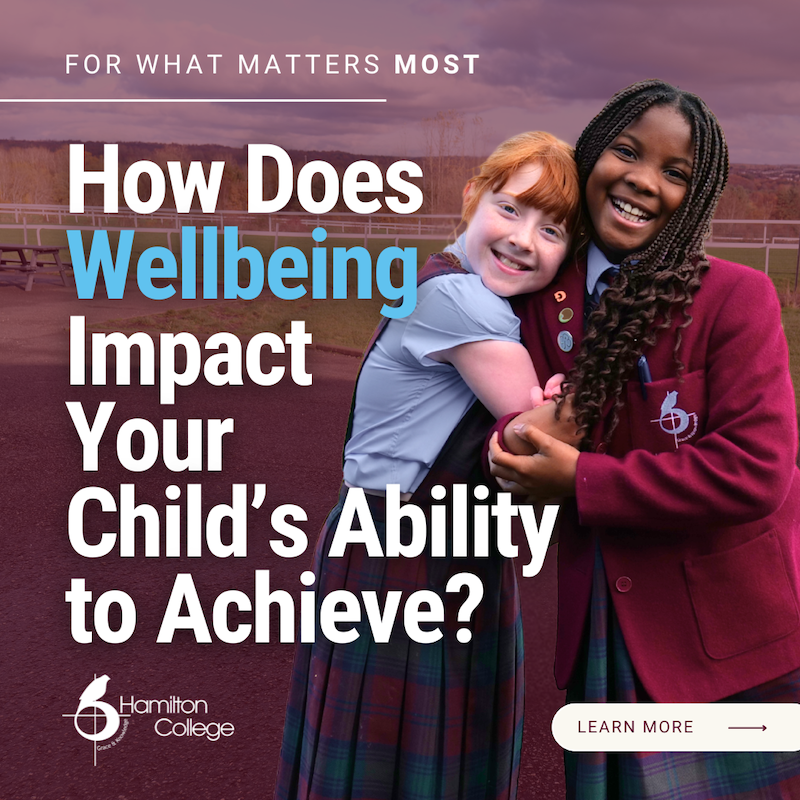

How Does Wellbeing Impact Your Child's Ability to Achieve at School?
Why enjoyment, security and support matter for learning and progress.
When we think about achievement at school, it is often focussed on teaching quality, curriculum and outcomes. While these are all important factors, there is one key area that can be overlooked: wellbeing.
The Social and Emotional Learning Report (2025) found that pupil wellbeing can contribute to up to three months’ additional academic progress in a single year.
Feeling happy and safe at school creates the conditions in which achievement can grow. That's why wellbeing is not an add-on at Hamilton College, it's a priority.
When Enjoyment Drops, So Does Progress
Across the UK, more than 1 in 7 children report feeling unhappy at school, according to the Good Childhood Report (2025).
When pupils feel anxious, unsettled, or disconnected from school, a significant amount of mental energy is spent managing those feelings. Learning becomes harder work, not because the content is more demanding, but because pupils are carrying additional emotional load into the classroom.
Academic challenge is essential for progress. What matters is why learning feels hard. To put it simply, raising attainment starts with raising enjoyment. We know our pupils are better equipped to deal with challenges when they enjoy school.
At Hamilton College, 98% of our pupils will keep trying even if the work is hard.
- Senior School Wellbeing Survey
Creating the Right Conditions for Learning
At Hamilton College, the aim is not to remove challenge, but to remove unnecessary barriers.
Clear pastoral systems, a strong behaviour policy and positive relationships between pupils and staff play an important role. When pupils feel comfortable approaching staff, concerns can be addressed early and effectively. Our pupils have the same pastoral teacher throughout their Senior School journey, ensuring continuity of care and allowing positive relationships to develop over time.
We are committed to being a safe place to thrive, and these conditions allow our pupils to focus their energy on learning itself.
This is reflected in our pupil feedback:
- 99% of pupils say they feel safe at school
- 95% say they like coming to school
- 100% say they have someone to talk to if they are struggling
The Impact on Your Child: Challenge that Supports Achievement
At Hamilton College, pupils are expected to think hard, engage with ideas and persevere with challenge. Academic rigour is an important part of learning.
What should not make school harder is anxiety about safety, belonging or whether support is available.
Pupils should be challenged by ideas, not by anxiety.
When pupils feel secure, challenge becomes productive. Learning feels purposeful rather than overwhelming, and pupils are more willing to contribute, ask questions and take intellectual risks.
As one parent shared:
“Both of my children say the school is fun and that the teachers are always respectful and supportive. They feel engaged, excited to learn, and genuinely happy in the Hamilton College environment.”
By creating the right conditions for learning, pupils are better able to achieve their potential.
Thinking About What Your Child Needs to Thrive?
Every child deserves an environment where they feel secure, supported and ready to learn.
If you would like to see how Hamilton College creates the conditions for both wellbeing and achievement, we would be delighted to welcome you to our Open Day on Wednesday 11 February.
Book now to explore how this environment helps every child feel ready to learn.
.png)











.jpg&command_2=resize&height_2=85 "From the Desk of the Headteacher - 2024/25 - Issue 3")